
From Battlefield to Bedside: EMS Guide to Junctional Tourniquets

Updated: Nov 16, 2025

You and your partner are working on a Saturday evening when the tones go off, law enforcement is requesting you to respond to a residence they are currently at after responding to a domestic in progress. Dispatch tells you that law enforcement has secured the scene and that your patient has been stabbed multiple times.
When you arrive to the scene, you enter the residence, and a law enforcement officer leads you into the kitchen where you find another officer kneeling on the floor holding direct pressure with a towel on a female patient’s left groin area. Officers tell you that the patient was stabbed multiple times with a butcher knife.
As your partner is putting the monitor on the patient, you conduct a rapid assessment. Currently, the patient will open her eyes when you talk to her. Her airway is open and patent, breathing is 22 and shallow, with bilateral chest rise and fall. Her skin is pale and sweaty, and you notice two open wounds to the left arm and a wound on her left hand. A tourniquet has been placed high on the left arm, and you don’t notice any bleeding from the open wounds. You check pulses and the left radial is absent and right radial is rapid and regular. As you continue, you notice the towel the officer is using to hold direct pressure to the wound in the groin is starting to become saturated with blood. You grab a trauma dressing and put that over the wounded area and tell the officer to continue to apply direct pressure. You look up at your partner and say, “I wish I had a junctional tourniquet”!
Treating Massive Hemorrhage
Approximately half of deaths from traumatic injuries in the United States are a result of massive hemorrhage or exsanguination. In EMS we have followed the Airway Breathing and Circulation algorithm for years. Traditionally, by prioritizing airways and breathing over circulation could prove to be problematic if the patient is bleeding out. Blood loss is the highest preventable cause of mortality in trauma and can be decreased by 10%-20% if we can stop it. This is why it is extremely important to prioritize circulatory support by focusing on stopping blood loss and resuscitation, which is why in 2008 the M.A.R.C.H algorithm was introduced by the military which prioritizes Massive Hemorrhage over airway and breathing.
Massive bleeding: Immediate control of severe hemorrhage.
Airway: Ensuring an open airway.
Respiration: Addressing breathing issues, such as tension pneumothorax.
Circulation: Managing fluids and addressing vascular access.
Hypothermia/Head injury: Preventing heat loss and managing head injuries.
Once you arrive to the patient bedside, if the patient has severe external bleeding from a limb, apply a commercially approved tourniquet directly to the skin, ideally two or three inches above the wound. Don’t wait in cases of traumatic amputation or bleeding that cannot be controlled with direct pressure or bandaging, a tourniquet should be placed. The tourniquet should be applied to stop bleeding within one minute and be fully secured within three minutes. Ensure you continuously reassess the tourniquet. Bleeding should be controlled, and the limb should not have a pulse. If bleeding continues after the first tourniquet is applied, place a second one above the first, offsetting the windlass to ensure adequate control.

For severe external bleeding that cannot be controlled with a tourniquet and if your guidelines allow, a hemostatic dressing should be used. Combat Gauze is generally considered the first-line option, but alternatives such as Celox Gauze, ChitoGauze, XStat or the iTClamp may also be effective. Hemostatic dressings should be applied with firm, direct pressure for at least three minutes to maximize effectiveness, except for XStat, which is designed differently. If bleeding continues, the initial dressing can be removed and replaced with a new one of the same or a different type. XStat, however, should not be removed in the field; instead, additional XStat, another hemostatic dressing, or a trauma dressing can be applied over it to add additional hemorrhage control.
If bleeding occurs in an area where a junctional tourniquet can be applied, place the device as soon as it is available, like tourniquets for extremities, do not delay once it is ready for use. If a junctional tourniquet is not on hand, or while it is being prepared, apply a hemostatic dressing with firm direct pressure to control bleeding until the tourniquet can be secured.
Junctional Tourniquets
Junctional tourniquets have only been around since the early to mid-2010s. The reason for junctional tourniquet manufacturing was based on military need after discovering that 19% of casualties on the battlefield in the Iraq and Afghanistan conflicts were exsanguinating from wounds in the groin and armpit. It was found that tourniquets for extremities had proven to be so successful in reducing morbidity and mortality secondary to traumatic hemorrhage. However, standard tourniquets didn’t work properly to stop the bleed for injuries in junctional areas.
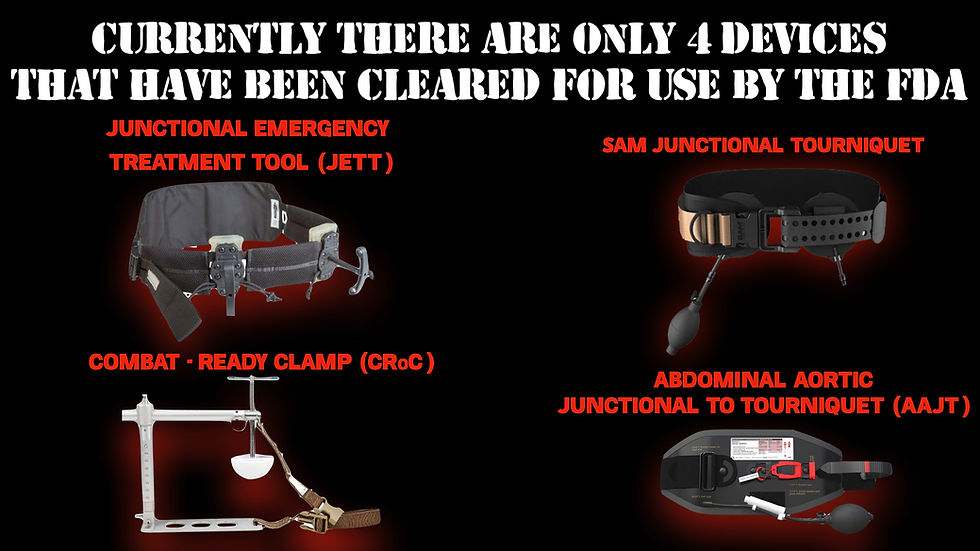
Recently, I had the opportunity to talk about these devices with a couple colleagues of mine who are active in the Army and Air Force. I was told that not all units have junctional tourniquets readily available or in their IVAK kits. However, if a team or unit determines there is a need for the device, they can be requested, ordered and then the team will get them. Those who have had opportunity to use a junctional tourniquet have stated there have experienced issues with the tourniquet working until the patient is moved to be transported. Once the patient is moved the tourniquet has the tendency to shift or move which releases pressure and the patient starts to bleed again.
Civilian Use in the Field
In civilian EMS, junctional tourniquets are not widely adopted and there may be a few reasons for this. First being to utilize junctional tourniquets in field, the state you practice must have them added to your scope of practice and according to my research, there are only a few states that have, like New York and Texas. Another example is in the state of Wisconsin; it is in the scope of practice for EMS professionals who have their tactical EMS endorsement and are members of SWAT teams.
Once the state you practice in adds junctional tourniquets to the scope of practice, medical directors will need to put forth protocols and policies for use. What I found interesting is that if you are wanting to purchase any of the FDA approved devices you have to have a “prescription” and prove you are following local and state regulations.
“This is a Prescription Device. To proceed, you must be a logged in customer and must attest to compliance with applicable laws.”
Another reason for civilian EMS not widely adopting them could be due to a consensus statement published in 2023 by the American College of Surgeons Committee on Trauma, the American College of Emergency Physicians, and the National Association of EMS Physicians regarding resuscitation of patients experiencing hemorrhage stated the following about junctional tourniquets:
“Junctional regions are where extremities join the torso, such as the shoulder/axilla or the groin, and are too proximal for extremity tourniquet application.
Junctional tourniquets are external compression devices that occlude blood flow from the aorta, axillary artery, or iliac artery to prevent hemorrhage.
Junctional tourniquet options include:
A belt that uses a windlass to tighten and stabilize its position on the axilla, abdomen, or groin. Once in place, a pneumatic bladder is inflated to provide targeted compression by occluding the axillary artery (recommended application time < 4 hours), the aorta (recommended application time < 1 hour), or the iliac artery (recommended application time < 4 hours).
A vice-like compression clamp that can be secured to the axilla or groin and tightened with a hand crank to occlude the underlying vasculature (recommended application time < 4 hours).
A belt that can be placed around the pelvis with 2 mechanical pressure pads or an inflatable bladder that occludes the iliac or femoral artery (recommended application time < 4 hours).
Junctional tourniquets are approved by the Food and Drug Administration (FDA) and Department of Defense. Currently, there is inadequate clinical experience and data in civilian trauma to routinely recommend these”.
According to my colleague in the Air Force, military trauma surgeons at Brooke Army Medical Center in San Antonio, Texas, have stated that there isn’t yet adequate evidence to widely implement junctional tourniquets in civilian EMS. This is probably because most military studies are conducted on the battlefield, including the use of junctional tourniquets, and we currently aren’t involved in any conflicts. The Department of Defense Trauma Registry reported only 39 junctional tourniquet uses out of 48,301 encounters between the years of 2007 and 2023.
If your service plans to adopt junctional tourniquets, it’s important to ensure compliance with state regulations. Establish clear protocols and quality assurance measures and provide thorough training on the specific device selected. Involving a subject matter expert with experience in junctional tourniquet use can be especially valuable, helping to ensure that training is accurate, consistent, and tailored to real-world applications. Partnering and collaborating with your local law enforcement or SWAT team would be a good idea as well.
Case Study Conclusion
You continue to control the patient’s junctional bleeding with assistance from another law enforcement officer who arrived on the scene by exposing the area and packing combat gauze in the wound and applied a junctional tourniquet he had in his IVAK kit. As you were doing that, your partner was able to get a large IV in and administered 2 grams of TXA followed by initiating a unit of whole blood. Fortunately, you were able to transport the patient to a local trauma center where the patient was taken directly to the surgical suite. Two days later you receive a follow up from the receiving facility that the patient is in the Trauma/Neuro ICU, is doing well and is projected to have a full recovery.

References
Abdominal Aortic and Junctional Tourniquet - Stabilized (AAJT-S). (2025). Www.narescue.com. https://www.narescue.com/abdominal-aortic-and-junctional-tourniquet-stablized-aajt-s.html
American College of Surgeons Committee on Trauma, the American College of Emergency Physicians, and the National Association of EMS Physicians. (2023). Prehospital Hemorrhage Control and Treatment by Clinicians: A Joint Position Statement. Annals of Emergency Medicine, 82(1), e1–e8. https://doi.org/10.1016/j.annemergmed.2023.03.017
Blair, A. (2025, August 26). Junctional Tourniquets [Personal communication].
JETT Junctional Emergency Treatment Tool. (2025). Narescue.com. https://www.narescue.com/pre-hospital-care-ems-products/march/junctional-emergency-treatment-tool-jett.html
Kragh, J. F., Mann-Salinas, E., Kotwal, R. S., Gross, K. R., Gerhardt, R. T., Kheirabadi, B. S., Wallum, T. E., & Dubick, M. A. (2013). Laboratory assessment of out-of-hospital interventions to control junctional bleeding from the groin in a manikin model. American Journal of Emergency Medicine, 31(8), 1276–1278. https://doi.org/10.1016/j.ajem.2013.03.021
Protocolo M.A.R.C.H, momento de ponerse los guantes y actuar - Boer Elite. (2019). Boer Elite. https://boer-elite.com/que-es-el-protocolo-m-a-r-c-h/
Schmit, M. (2025, September 2). Junctional Tourniquets [Personal Communication].
Reneau, H. B., Long, B. J., Rizzo, J. A., Fisher, A. D., April, M. D., & Schauer, S. (2024). An Analysis of Junctional Tourniquet Use Within the Department of Defense Trauma Registry. Journal of Special Operations Medicine, 24(4), 40. https://doi.org/10.55460/ndc5-j2lu
Tactical Combat Casualty Care (TCCC) Guidelines Basic Management Plan for Care Under Fire/Threat. (2024). https://learning-media.allogy.com/api/v1/pdf/f4cf1d4e-3191-443a-befc-415838fb04f2/contents
Tourniquets in TCCC. (2024). Allogy.com. https://books.allogy.com/web/tenant/8/books/a30c619d-7270-4bfe-be4f-eb4d27adc783/#idbb0ed3c8-707d-4ae7-a768-53e1439f5800
Vymazal, T. (2023). Massive hemorrhage management – a best evidence topic report. Therapeutics and Clinical Risk Management, 1107. https://doi.org/10.2147/tcrm.s88878


